Tuesday, March 10, 2009


Lake Victoria is the world’s second largest fresh water lake. It lies between the two rift branches of the Rift Valley. The lake is at an altitude of 1.134 metres above sea level and it is 82 metres deep. In the lake, there used to be more than 400 fish species. To promote sports fishing, the Nile Perch and the Nile Tilapia were introduced to the lake in the 1960’s, and they are now believed to have caused a dramatic fall in the number of the other fish species. Fishing is an important industry in Ukerewe District and a lot of fishing boats, as well as canoes and traditional dhows, can be seen plying the narrow waters between the many smaller islands.
hamlets, where the local fishermen land their night’s catch. Ukerewe is a paradise for birdwatchers, especially at the west shore and on its smaller islands. Here is found an abundance of different birds including the beautiful Fishing Eagle, Cormorants, and an occasional Crowned Crane. Sports fishing are possible on almost any location around the island.

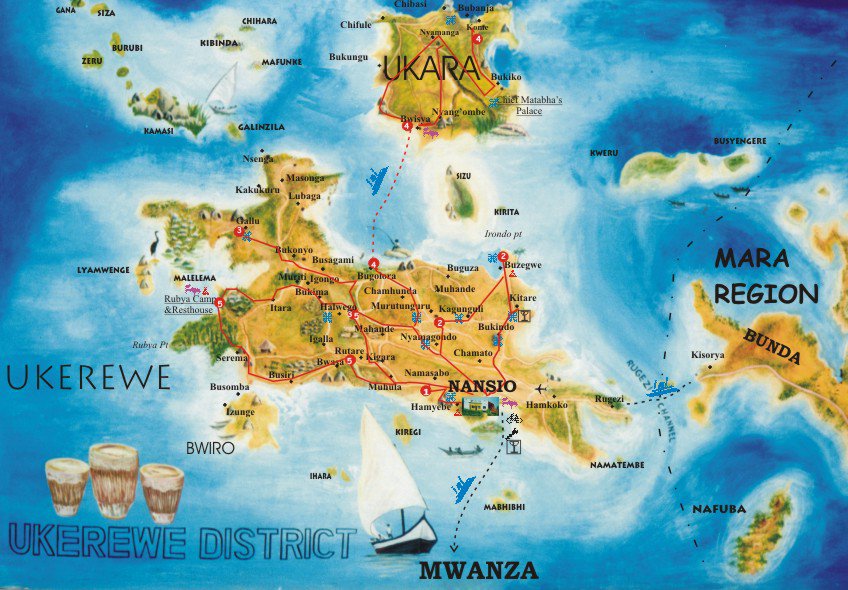
Ukerewe Island is 50 kms long and between 25 to 35 kms wide. It is a rocky island with smaller hills. The subsoil is dominated by crystalline rocks - from the oldest Precambrian earth period-, which are strongly lateralised. The landscape varies between flat land, cassava and rice fields, fruit plantations, rocks, rocky and sandy shores, beautiful lakeshores, and pine forest. The main town on Ukerewe is Nansio; where the ferries from Mwanza arrive and as well accommodate the district headquarter.
Most inhabitants are living in the many traditional villages scattered around the island.

Ukerewe Island


LARGEST LAKE ISLANDS

Manitoulin, Lake Huron - (1,068 sq miles) (2,766 sq km)

Vozrozhdeniya, Aral Sea - (888 sq miles) (2,300 sq km)

Rene-Lavasseur, Manicouagan Reservoir, Quebec, Canada - (780 sq miles) (2,000 sq km)
Olkhon, Lake Baykal - (282 sq miles) (730 sq km)

Samosir, Toba - (243 sq miles) (630 sq km)

Isle Royal, Lake Superior - (209 sq miles) (541 sq km)

Ukerewe, Lake Victoria - (205 sq miles) (530 sq km)

St. Joseph, Lake Huron - (141 sq miles) (365 sq km)

Drummond, Lake Huron - (134 sq miles) (347 sq km)


Idjwi, Lake Kivu, DRC - (110 sq miles) (285 sq km)

Sunday, March 1, 2009

Surgery on Ukerewe


The island is the largest in Lake Victoria measuring 50 by 35 km and the 2002 census data was a population of just over 260,000. Surgical care on the island is provided locally in community dispensaries which refer to the Nansio district hospital. There are traditional healers on the island and private clinics which provide no surgical care. The district hospital was built in 1956 and has 8 wards. These are male and female medical, male and female surgical, paediatric, labour and delivery, isolation and private wards. The surgical wards have 10 beds each but frequently house 20 to 25 patients in the beds. The operating room suite has 1 operating room, a minor procedure room which has the scrub sinks for the main or (although there was running water only one day that I was there), a prep room with one small functioning autoclave (powered by a kerosene burner) a storage and supply room . The windows are open for ventilation and several of the screens are missing. I am not certain of the level of sterility and was not there long enough to get an idea of clean case infection rates. I did see a large number of incisional hernias secondary to abdominal surgery especially caesarean sections. The causes of these are likely related to the infection rate, type of sutures used (normally they have only chromic catgut and silk ) , the fact that patients have no muscle relaxation during closure and the overall nutritional status of the patients.

The statistics for 2008 surgeries performed at the hospital were 415 cases of which 150 were caesarean sections and a significant other proportion were related to obstetrical care, burst abdomens follow section, curettage ectopic pregnancy and missed abortion. A number of other surgeries done were surgeries done by visiting doctors. The largest numbers of these were performed by doctors from KCMC and also a visiting ophthalmologist. Most of these were hernia repairs and similar surgeries and patients were charged for all of these procedures. The cost for a hernia repair for example is 30,000 shillings. Repair of burst abdomen cost 40,000 shillings. During the caravan I performed 54 major surgical procedures with no charge to the patient. The surgical assistance during the cases was Dr. Makarius a medical officer at Nansio. The types of procedure done by myself included hernia repairs, salpingo-oophorectomies, burn contracture release, mastectomy, removal of keloids, parotid tumours and others. A large number of other types of surgical cases were seen in clinic and I did not perform them because of the level of complexity and lack of anaesthetic and surgical resources. Examples included large symptomatic goitres, menometrorrhagia requiring hysterectomy, paediatric anomalies such as ectopy of the bladder and cleft palates, and orthopaedic cases such as osteomyelitis and club feet. I saw over 200 patients in the clinic who were either operated on by me, referred to BMC (Bugando Medical Centre) or declined surgery. Many more patients were appropriate for surgery but were turned away because of lack of time to be able to do these surgeries. Many of the patients referred to BMC will not be seen there because of the cost of taking the ferry to Mwanza , the cost of that they will be charged when they get there and a mistrust of the care that they will receive there.

The anaesthesia for all the surgeries was provided by the nurse anaesthetists who provided intravenous Ketamine and when available Vallium. We had to obtain the Vallium for the surgeries and it is my impression that much of the surgeries done regularly are done with Ketamine alone. No spinal anaesthesia was provided even though the anaesthetists have been trained in this because of lack of needles and medications. No inhalational anaesthesia is administered because of lack of endotracheal tubes and lack of experience in their use by the anaesthetists. Monitoring during anaesthesia is vital signs only. Depth of anaesthesia is by response to painful stimuli and there is no measurement of oxygenation during the case. Local anaesthesia is seldom used in addition to the sedation again because of lack of availability of the drugs. Post operative pain relief was oral paracetamol or tramadol with no narcotics available for either oral or parenteral use. Most patients following surgery had significant amounts of pain.