Tuesday, March 10, 2009


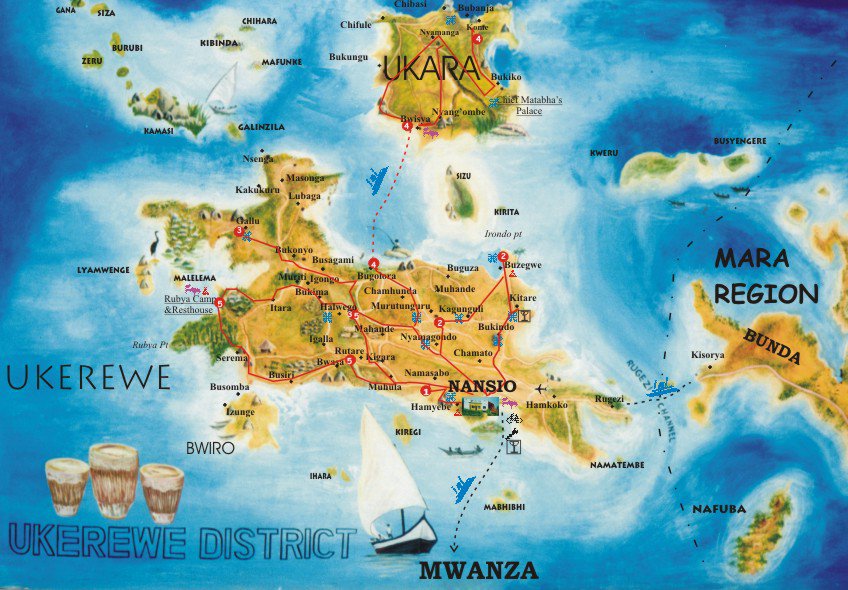
Lake Victoria is the world’s second largest fresh water lake. It lies between the two rift branches of the Rift Valley. The lake is at an altitude of 1.134 metres above sea level and it is 82 metres deep. In the lake, there used to be more than 400 fish species. To promote sports fishing, the Nile Perch and the Nile Tilapia were introduced to the lake in the 1960’s, and they are now believed to have caused a dramatic fall in the number of the other fish species. Fishing is an important industry in Ukerewe District and a lot of fishing boats, as well as canoes and traditional dhows, can be seen plying the narrow waters between the many smaller islands.
hamlets, where the local fishermen land their night’s catch. Ukerewe is a paradise for birdwatchers, especially at the west shore and on its smaller islands. Here is found an abundance of different birds including the beautiful Fishing Eagle, Cormorants, and an occasional Crowned Crane. Sports fishing are possible on almost any location around the island.

Ukerewe Island is 50 kms long and between 25 to 35 kms wide. It is a rocky island with smaller hills. The subsoil is dominated by crystalline rocks - from the oldest Precambrian earth period-, which are strongly lateralised. The landscape varies between flat land, cassava and rice fields, fruit plantations, rocks, rocky and sandy shores, beautiful lakeshores, and pine forest. The main town on Ukerewe is Nansio; where the ferries from Mwanza arrive and as well accommodate the district headquarter.
Most inhabitants are living in the many traditional villages scattered around the island.

Ukerewe Island


LARGEST LAKE ISLANDS

Manitoulin, Lake Huron - (1,068 sq miles) (2,766 sq km)

Vozrozhdeniya, Aral Sea - (888 sq miles) (2,300 sq km)

Rene-Lavasseur, Manicouagan Reservoir, Quebec, Canada - (780 sq miles) (2,000 sq km)
Olkhon, Lake Baykal - (282 sq miles) (730 sq km)

Samosir, Toba - (243 sq miles) (630 sq km)

Isle Royal, Lake Superior - (209 sq miles) (541 sq km)

Ukerewe, Lake Victoria - (205 sq miles) (530 sq km)

St. Joseph, Lake Huron - (141 sq miles) (365 sq km)

Drummond, Lake Huron - (134 sq miles) (347 sq km)


Idjwi, Lake Kivu, DRC - (110 sq miles) (285 sq km)

Sunday, March 1, 2009

Surgery on Ukerewe


The island is the largest in Lake Victoria measuring 50 by 35 km and the 2002 census data was a population of just over 260,000. Surgical care on the island is provided locally in community dispensaries which refer to the Nansio district hospital. There are traditional healers on the island and private clinics which provide no surgical care. The district hospital was built in 1956 and has 8 wards. These are male and female medical, male and female surgical, paediatric, labour and delivery, isolation and private wards. The surgical wards have 10 beds each but frequently house 20 to 25 patients in the beds. The operating room suite has 1 operating room, a minor procedure room which has the scrub sinks for the main or (although there was running water only one day that I was there), a prep room with one small functioning autoclave (powered by a kerosene burner) a storage and supply room . The windows are open for ventilation and several of the screens are missing. I am not certain of the level of sterility and was not there long enough to get an idea of clean case infection rates. I did see a large number of incisional hernias secondary to abdominal surgery especially caesarean sections. The causes of these are likely related to the infection rate, type of sutures used (normally they have only chromic catgut and silk ) , the fact that patients have no muscle relaxation during closure and the overall nutritional status of the patients.

The statistics for 2008 surgeries performed at the hospital were 415 cases of which 150 were caesarean sections and a significant other proportion were related to obstetrical care, burst abdomens follow section, curettage ectopic pregnancy and missed abortion. A number of other surgeries done were surgeries done by visiting doctors. The largest numbers of these were performed by doctors from KCMC and also a visiting ophthalmologist. Most of these were hernia repairs and similar surgeries and patients were charged for all of these procedures. The cost for a hernia repair for example is 30,000 shillings. Repair of burst abdomen cost 40,000 shillings. During the caravan I performed 54 major surgical procedures with no charge to the patient. The surgical assistance during the cases was Dr. Makarius a medical officer at Nansio. The types of procedure done by myself included hernia repairs, salpingo-oophorectomies, burn contracture release, mastectomy, removal of keloids, parotid tumours and others. A large number of other types of surgical cases were seen in clinic and I did not perform them because of the level of complexity and lack of anaesthetic and surgical resources. Examples included large symptomatic goitres, menometrorrhagia requiring hysterectomy, paediatric anomalies such as ectopy of the bladder and cleft palates, and orthopaedic cases such as osteomyelitis and club feet. I saw over 200 patients in the clinic who were either operated on by me, referred to BMC (Bugando Medical Centre) or declined surgery. Many more patients were appropriate for surgery but were turned away because of lack of time to be able to do these surgeries. Many of the patients referred to BMC will not be seen there because of the cost of taking the ferry to Mwanza , the cost of that they will be charged when they get there and a mistrust of the care that they will receive there.

The anaesthesia for all the surgeries was provided by the nurse anaesthetists who provided intravenous Ketamine and when available Vallium. We had to obtain the Vallium for the surgeries and it is my impression that much of the surgeries done regularly are done with Ketamine alone. No spinal anaesthesia was provided even though the anaesthetists have been trained in this because of lack of needles and medications. No inhalational anaesthesia is administered because of lack of endotracheal tubes and lack of experience in their use by the anaesthetists. Monitoring during anaesthesia is vital signs only. Depth of anaesthesia is by response to painful stimuli and there is no measurement of oxygenation during the case. Local anaesthesia is seldom used in addition to the sedation again because of lack of availability of the drugs. Post operative pain relief was oral paracetamol or tramadol with no narcotics available for either oral or parenteral use. Most patients following surgery had significant amounts of pain.

Tuesday, February 24, 2009

Nansio. Ukewere Island Tanzania.

The Island of Ukewere is situated in the middle of lake Victoria and is a ferry boat ride of about 31/2 hours north of Mwanza. The ferry boats leave Mwanza harbour and carry everything that goes to or comes from the island the Island. The island does have an airstrip but I spoke to the Kenyan who looks after it and no planes have landed there in a few years. While we were coming in on the ferry there was much excitement because a small float plane had crashed upon an attempted landing at Nansio harbour. No-one was seriously hurt but a it took a few days to salvage and some very sheepish Mzungus were loading it onto a boat to take back to Mwanza. They even duct tapped over the name on the side of the plane when they saw me taking photos!
The fact that is an island gives Ukewere a very special feeling. A safety that because it has geographical boundaries and that everyone knows everyone else's business, that nothing major criminal would happen to us. The same isolation that also made it impossible to get any health care that was not already on the island.
When we arrived everybody knew who we were. I know lots of individual white people had been there but I am not sure if they had seen such a bunch of Mzungus before. Most of all the children were absolutely fascinated by us and they were so happy and full of life that immediately I fell in love with the place. The level of poverty in these children was very apparent and many of them wore torn clothing and had no shoes. However children took care of younger siblings and it wasn't at all uncommon to see girls of 4 or 5 years of age with a baby in a cloth strapped to their back. Most of the children loved to have their pictures taken so that they could see themselves on the camera. This was always followed by a near riot of laughing and shouting.

Monday, February 23, 2009

The bishop and Bugando.


Mwanza is the second Largest city in Tanzania. It doesn't feel it. It doesn't have that urban feeling that dar has or even the slight agressiveness that surrounds you in arusha. The buildings on all the granite cliffs alow the shanty town shacks to blend in with the topography. There are some larger buildings including Bugando Medical Center (BMC) it is on the side of a hill, is nine stories and looks out over mwanza harbour. It is an ugly concrete building and we visited it on the first day with the bishop. Mange Manyama ( a Phd student working at U of C from bugando) had given me an email of introduction to a professor Magori there. O course he was away from Mwanza while I was there. This is only important because next time I come I want to offer my services to do some teaching . Bugando was to become a little bit of a thorn in my side when at Nansio because of the difficulties of getting any referals to them.
The bishop is physically not a big man but almost everything on ukewere circulate around him.
The bishop picked up Warren ( a pharmacist)and me from the airport. We arrived from different directions -me from Dar es salaam and Warren from Nairobi though ironically we both travelled through heathrow on British airways at the same time. We arrived the day before the large contingent from Canada and the bishop put us to political use right away. The first trip was to a convent to meet with the bishop's sister for a medical consult. Which reminds me I must get some support stockings for her. We visited Bugando and also the bottling plant where he made sure we had a supply of bottled water for the whole of the caravan. we then went to mds supplier of the medications for the caravan. This is where I saw Warren in action for the first time. A truly amazing sight. Excessively pharmaceutical anal retentive behaviour. We met up there with Rainer Tan the on the ground coordinator/Cida intern. Warren made sure we had all the drugs and Rainer made sure everything was paid for and loaded on a truck. Pity that, because we weren't leaving on the ferry until the next day and mds was not open on the Saturday and that nothing would be safe on the truck overnight, we had to unload the truck into a local dawa (pharmacy) for overnight storage and reload in the morning! I know that is a long run on sentence but it was a long African run on behaviour. That night Rainer, Warren and I stayed at a very seedy place called the geiter lodge. (12,000 shillings a night--about $9).

Sunday, February 22, 2009

Jan 09 Mission arrival

Since I had no Internet for most of my time in Africa I have decided to write a retrospective diary from notes and memories jogged by my photographs.

Arriving in Mwanza alone by plane was eventful. As I landed the heavens opened up to a great African rain. It happened there about once a day at different times of day and caused everything to be put on hold for about 1/2 an hour and just as they come they are over in no time. I waited about 1 hour for warren's plane (Warren is a pharmacist from Nova Scotia on his 8th or 9th mission.) Then we were met by the Bishop. He deserves his own blog entry. Mwanza airfield is amongst paddy fields that are populated by egrets and those ugly looking Maribou storks. The road into town has deep gutters on either side so that the torrential rain flows off. The road is full of commerce. Bikes, carts and anything that moves being taken along for trade. Lots being carried on the head. No wonder the commonest complaint is Neck and back pain.

Mwanza is called the city of rocks because of the amazing granite formations. The metamorphic rock has been stripped of any sedimentary rock around and has left huge sculptures rather like Henry Moore's. They dominate the scenery around the harbour and all the slopes around the town. Large number of water birds and birds of prey circulate in the hot air coming from the sun on these rocks. The power of the updraughts is incredible. winds can pick up very quickly and oh that Dust. Not the same red dust as Kilema but eye irritating and with a taste that is hard to forget. It is still on many of the things I brought back.

Tuesday, January 20, 2009

Flying to Tanzania tomorrow.
I am looking forward to this trip with more insight than the last but with just as much excitement.

Friday, January 16, 2009


I just packed my melarone, so it reminded me to look up how very common Malaria is in Tanzania. Ukewere is right in the middle of red zone. Kilema is in the yellow because of its height on kilimanjaro. The predominant species is Plasmodium falciparum, the most dangerous of the four species of human malaria. Malaria causes an estimated 2.7 million deaths per year, most occurring in Africa. Ninety percent of the world's malaria cases occur in Africa. Chloroquine resistance is widespread. Outbreaks are being reported in locations thought to be at elevations too high for transmission. This may be due to climatic change or human migration. Also, malaria has resurged in certain locations that had previously had effective control programs, such as Zanzibar. Malaria occurs in more in poor districts but itself causes a major burden on health and economic resources impoverishing further the community. This truly vicous cycle must be broken.
Tanzania Population:40.2 million
Life expectancy at birth:50 years(male), 53 (female)
Population at risk of malaria 93%
Under-5 mortality rate:112/1000, or approximately 1 in 6 children
This disease is responsible for more than one-third of deaths among children under age 5
In 2000, 55 percent of hospital admissions in under-five children were due to malaria.
Up to 80 percent of Tanzania's malaria deaths occur among these children.
The Net NeedLong-lasting insecticide-treated nets (LLINs)
Total Nets Needed to Reach Universal Coverage Before the End of 2010 21,434,584
Total Nets Needing to Be Replaced Before the End of 2010 93,000
Total Nets Pledged (not necessarily delivered)to End of 2010 19,608,199
Net Gap 1,919,385

Thursday, January 15, 2009

note sister clarrissa has my hand in hers and her cell (ring tone "red red wine") in the other.
United Republic of Tanzania Facts from BBC web page
Population: 41.5 million (UN, 2008)
Capital: Dodoma (official), Dar es Salaam (commercial)
Area: 945,087 sq km (364,900 sq miles)
Major languages: English, Swahili
Major religions: Christianity, Islam
Life expectancy: 51 years (men), 54 years (women) (UN)
Monetary unit: 1 Tanzanian shilling = 100 cents
Main exports: Sisal, cloves, coffee, cotton, cashew nuts, minerals, tobacco
GNI per capita: US $400 (World Bank, 2007)
Internet domain: .tz
International dialling code: +255

HISTORY>
1498 - Portuguese explorer Vasco da Gama visits Tanzanian coast.
1506 - Portuguese succeed in controlling most of the East African coast.
1699 - Portuguese ousted from Zanzibar by Omani Arabs.
1884 - German Colonisation Society begins to acquire territory on the mainland.
1886 - Britain and Germany sign an agreement allowing Germany to set up a sphere of influence over mainland Tanzania, except for a narrow piece of territory along the coast which stays under the authority of the sultan of Zanzibar, while Britain enjoys a protectorate over Zanzibar.
1905-06 - Indigenous Maji Maji revolt suppressed by German troops.
1916 - British, Belgian and South African troops occupy most of German East Africa.
1919 - League of Nations gives Britain a mandate over Tanganyika - today's mainland Tanzania.
1929 - Tanganyika African Association founded.
1946 - United Nations converts British mandate over Tanganyika into a trusteeship.
1954 - Julius Nyerere and Oscar Kambona transform the Tanganyika African Association into the Tanganyika African National Union.
1961 - Tanganyika becomes independent with Julius Nyerere as prime minister.
1962 - Tanganyika becomes a republic with Nyerere as president.
1963 - Zanzibar becomes independent.
1964 - Sultanate of Zanzibar overthrown by Afro-Shirazi Party in a violent, left-wing revolution; Tanganyika and Zanzibar merge to become Tanzania.
1967 - Nyerere issues the Arusha Declaration, which calls for egalitarianism, socialism and self-reliance.
Present President: Jakaya Kikwete

Wednesday, January 14, 2009

Thursday, January 8, 2009


Time is speeding by andI am leaving Calgary on 21st january (Rosie's birthday! she is such a sport). I am not travelling with the group because I can get a direct flight from Calgary to heathrow and so just 2 flights to tanzania and also allows me to stop in on my parents in England on the way back without extra cost. The rest of the group including Michelle , Chris and others leave Montreal on the 22nd I believe. I will miss some of the camaraderie that travelling together brings.
Kristina and the next kilema mission leave Montreal 2 weeks later.I will be at kilema for the first week of that caravan.

My plans for future caravans at the moment are to go again in October. However there may be more need for a surgeon on the fall trip to Uganda. I will have to see how the wind blows when I am back. As I found out when you think of plans to suit yourself they can fall through. But somehow everything does work out for the best.

Happy New Year