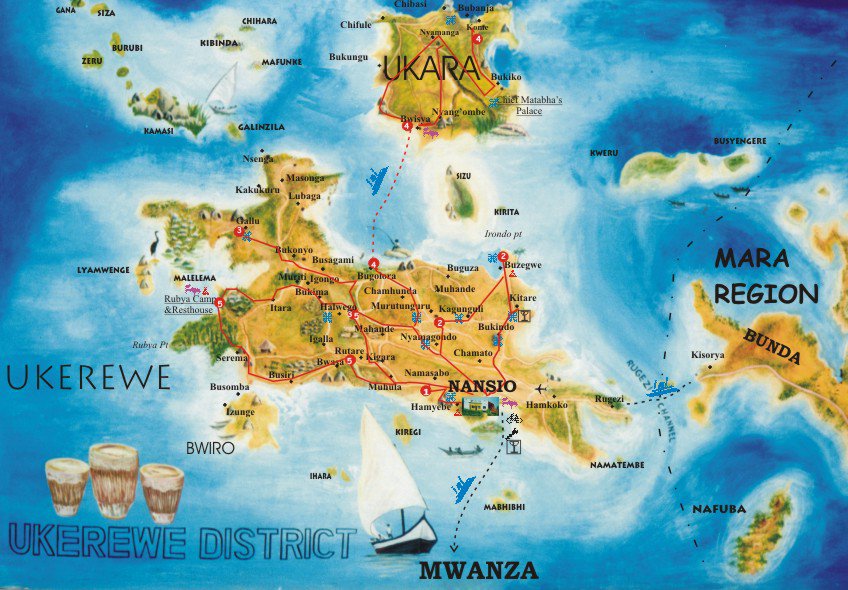
This is the reply to an email I got from one of our very young logistics people following the last mission.
From: Rachel
I had an amazing time with you guys, you really made the trip, and i hope to get a job and return to my other home with all of you. also for my video, i wanted to ask everyone "what makes you want to go back to ukurewe " and "do you think we made a large impact on the island"? Anything else you wanna tell me about your experience would be great :)Dear Rachel
You ask such big questions!!!
Here is my very reply this next piece is adapted from Wikipedia
The Star Thrower" (or "starfish story") is part of a 16-page essay of the same name by Loren Eiseley (1907–1977), published in 1969 in The Unexpected Universe. The Star Thrower is also the title of a 1978 anthology of Eiseley's works (including the essay), which he completed shortly before his death.
The original story
The story describes the narrator walking along the beach early one morning, when he sees a man picking up a starfish off the sand and throwing it into the sea. The narrator is observant and subtle, but skeptical. He has the last word, a pessimistic conclusion. Some excerpts:
| In a pool of sand and silt a starfish had thrust its arms up stiffly and was holding its body away from the stifling mud. "It's still alive," I ventured. "Yes," he said, and with a quick yet gentle movement he picked up the star and spun it over my head and far out into the sea. It sunk in a burst of spume, and the waters roared once more. ..."There are not many who come this far," I said, groping in a sudden embarrassment for words. "Do you collect?" "Only like this," he said softly, gesturing amidst the wreckage of the shore. "And only for the living." He stooped again, oblivious of my curiosity, and skipped another star neatly across the water. "The stars," he said, "throw well. One can help them." ..."I do not collect," I said uncomfortably, the wind beating at my garments. "Neither the living nor the dead. I gave it up a long time ago. Death is the only successful collector." | ” |
| —The Star Thrower, p. 172 |
Later, the narrator says:
..."On a point of land, I found the star thrower...I spoke once briefly. "I understand," I said. "Call me another thrower." Only then I allowed myself to think, He is not alone any longer. After us, there will be others...We were part of the rainbow...Perhaps far outward on the rim of space a genuine star was similarly seized and flung...For a moment, we cast on an infinite beach together beside an unknown hurler of suns... We had lost our way, I thought, but we had kept, some of us, the memory of the perfect circle of compassion from life to death and back to life again - the completion of the rainbow of existence" (The Star Thrower, p.181).
The story has been adapted and retold by motivational speakers and on internet sites, often without attribution, since at least the mid 1980s.
In this version the conversation is related between other characters, an older man and a younger one, a wise man and a little girl, or Jesus and a man. Usually stating the obvious that to the one starfish it made a difference.
It was also adapted into a children's story in 2006. Called, "Sara and the Starfish." It re-tells the story from the eyes of a young girl as well as the starfish itself, though the moral of the story is the same as the original idea told by Eiseley.
Now you ask- what does this mean to us!
I know we made a difference to individuals on the Island. I know people there are happy that other people in the world care about their existence.
The skeptic will say so what does that all matter in the big scheme of things. They may be right that helping one starfish on one beach in this big world is inconsequential, Not everyone is good at working on the big picture and personally I have observed that big in Africa often leaves out UKEREWE. So Yes I will be going back and yes I believe we make an impact.
Love to all who care about ukerewe
Babu Marki.